
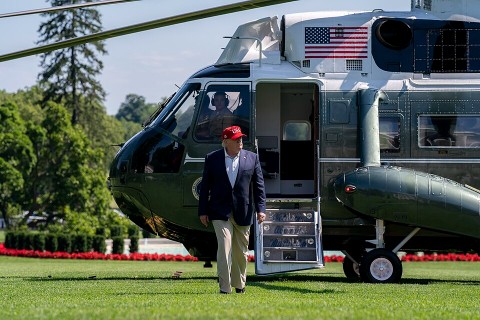
In a move that could potentially affect US-China relations, former President Donald Trump has expressed his intention to speak with Taiwan’s President Lai Ching-te. Speaking at Joint Base Andrews in Maryland, Trump mentioned his willingness to engage with Lai, referring to the ongoing “Taiwan problem.” This would mark the first direct communication between leaders of the US and Taiwan since Washington recognized Beijing over Taipei in 1979. Trump’s statement follows a similar comment made after his meeting with Chinese leader Xi Jinping, indicating a consistent interest in dialogue with Taiwan despite the absence of a scheduled call.
Taiwan’s foreign ministry responded positively to Trump’s remarks, stating that President Lai would be pleased to converse with the US leader. The historical context underscores the significance of such a dialogue; Trump had previously broken diplomatic norms by speaking with then-Taiwan President Tsai Ing-wen in 2016, which led to China lodging a formal complaint. Beijing’s stance on Taiwan remains firm, as it has not ruled out using force to assert control over the island, and it views US military support for Taiwan as a provocative act.
The Trump administration has a record of approving substantial arms sales to Taiwan, surpassing any previous US president in this regard. However, Trump’s characterization of these sales as a “very good negotiating chip” adds complexity to the US’s position. Following his recent visit to Beijing, Trump has yet to decide on a major $14 billion arms deal with Taiwan, leaving the future of US-Taiwan relations uncertain. The situation is further complicated by reports that Beijing is delaying approval for a visit by Pentagon official Elbridge Colby until Trump’s decision on the arms sale is made.
China views any direct interaction between US and Taiwanese leaders as a challenge to its territorial claims over Taiwan. Yet, Trump’s comments have created mixed messages for Taipei. President Lai, who Beijing considers a separatist, has expressed a desire to maintain the status quo across the Taiwan Strait, accusing China of destabilizing the region through military expansion. Lai’s stance emphasizes Taiwan’s commitment to democracy and freedom, challenging any notion of annexation by China.
Under US law, Washington is obliged to aid Taiwan in its defense. This commitment is reinforced by bipartisan support from US lawmakers urging continued arms sales to the island. Despite its smaller population compared to China, Taiwan’s strategic importance is highlighted by its position as the fourth-largest trading partner of the US, thanks in large part to its semiconductor exports that are vital to the global economy.